
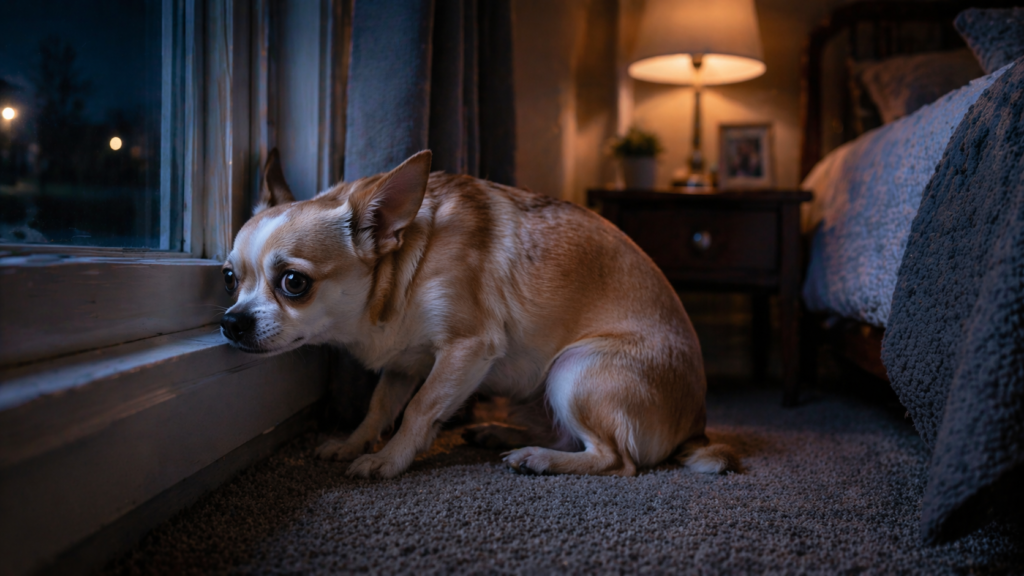
It usually starts the same way.
Everything seems normal during the day.
Your dog eats, plays, goes on walks — nothing unusual.
But at night, something changes.
They start pacing.
They won’t lie down.
Sometimes they stare at the door, or follow you from room to room like they’re waiting for something.
If that sounds familiar, you’re not dealing with random behavior — you’re looking at night-specific anxiety patterns.
What’s different about nighttime?
Night changes the environment in ways we don’t always notice.
- The house gets quieter
- External sounds stand out more
- Your routine slows down
- Your dog has less distraction
For some dogs, this creates a kind of “awareness spike” — they become more alert, not less.
From experience, this is especially common in dogs that already have mild anxiety during the day.
A mistake many owners make
Most people try to “calm the dog down” directly:
- Talking to them
- Petting them more
- Letting them move freely around the house
But this often does the opposite.
It teaches the dog: “When I feel anxious, I get more attention.”
That reinforces the behavior instead of reducing it.
What actually works (and why)
Instead of reacting to anxiety, you want to change the state before it happens.
1. Shift the energy earlier in the evening
A dog that hasn’t fully “used up” its energy won’t suddenly relax at night.
Try:
- A slightly longer walk
- Short bursts of play
- Basic obedience training
The goal isn’t exhaustion — it’s mental and physical balance.
2. Give your dog a “job” before sleep
Dogs relax faster when their brain is engaged.
Something simple like a snuffle mat or food puzzle can:
- Redirect focus
- Reduce nervous pacing
- Create a transition into rest
Some dogs that struggle to settle will lie down within minutes after this kind of activity.
3. Reduce uncertainty
Night anxiety is often about “not knowing what’s happening.”
You can lower that by making the environment predictable:
- Same sleep location
- Same timing
- Same sequence before bed
Dogs don’t just like routine — they depend on it.
4. Control the environment (don’t ignore it)
At night, small sounds feel amplified.
Try:
- Light background noise
- Closing certain doors
- Reducing outside triggers
You’re not “hiding reality” — you’re removing unnecessary stress inputs.
When it’s not just a nighttime issue
If your dog:
- Is already anxious during the day
- Has separation issues
- Shows constant restlessness
Then nighttime anxiety is just a symptom, not the root problem.
In that case, you need to address the broader behavior pattern — not just bedtime.
The goal isn’t “perfect calm”
A completely silent, motionless dog isn’t the goal.
What you’re aiming for is:
A dog that can settle, relax, and stay in one place without stress
That’s a much more realistic — and achievable — outcome.
Final thought
Night anxiety feels frustrating because it disrupts your rest.
But for your dog, it’s usually confusion, not defiance.
Once you shift from “reacting” to “preparing,” the behavior often changes faster than expected.