
The short version: Dog stranger anxiety — also called dog fear of strangers or dog social anxiety — is one of the most misunderstood behavior problems in pet dogs. It’s not aggression, it’s not “dominance,” and it’s not a personality flaw. It’s fear. This guide walks you through recognizing it, understanding why it happens, a week-by-week training plan, and the one special case most guides skip: preparing your anxious dog for a new baby.
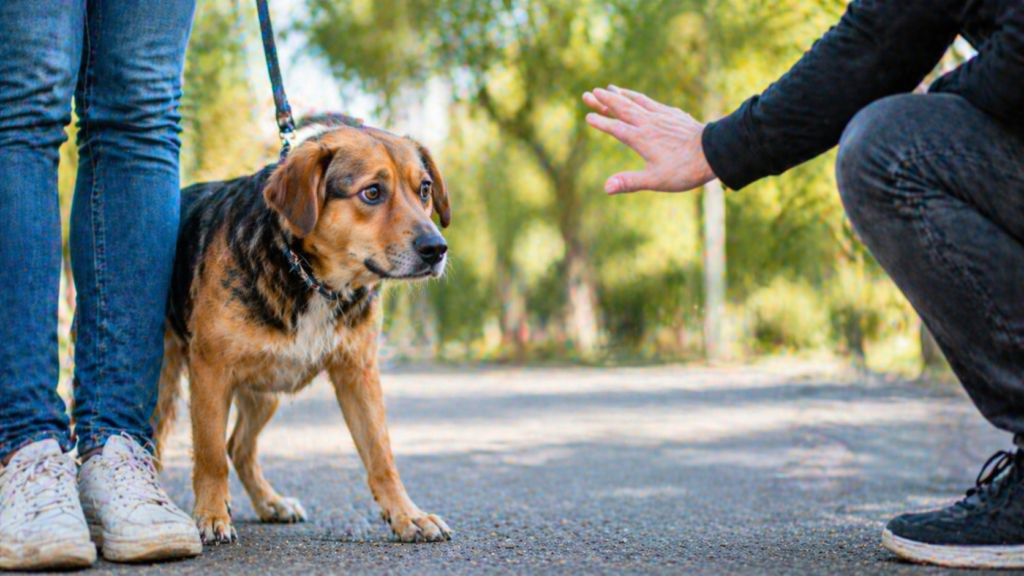
Your dog is perfectly happy at home. Then a stranger walks through the door, or you pass someone on the street, and everything changes — barking, hiding, trembling, or a full freeze. You’re embarrassed, the stranger is uncomfortable, and your dog is genuinely distressed.
Dogs that are scared of strangers are often labeled “aggressive” or “antisocial.” In reality, stranger anxiety in dogs is almost always rooted in fear — fear that, with the right approach, can be meaningfully reduced. Most dogs will never become golden retrievers who love everyone, but most can learn that strangers aren’t a threat.
In this guide
- What dog stranger anxiety looks like
- Stranger anxiety vs. aggression
- Why your dog is scared of strangers
- Special case: dogs and new babies
- Step-by-step desensitization training
- Products that can help
- When to get professional help
- Frequently asked questions
What Does Dog Stranger Anxiety Look Like?
One reason dog fear of strangers goes unaddressed for so long is that the early signs are easy to miss or misread. By the time a dog is barking or lunging, the anxiety has often been building for years.
Mild signs of dog stranger anxiety
- Moving behind the owner when a stranger approaches — using you as a shield
- Head lowered, ears pinned back, tail tucked — the classic appeasement posture
- Calming signals: yawning, lip-licking, looking away, sniffing the ground. These are your dog’s way of saying “I’m uncomfortable” — not signs that they’re relaxed
- Refusing treats from or near strangers — a dog that won’t eat is a dog that’s too stressed to function normally
- Whale eye — showing the whites of the eyes when a stranger is nearby
Moderate signs
- Persistent barking at strangers from a distance — often with a high, sharp tone
- Pacing or inability to settle when someone unfamiliar is in the space
- Growling when approached — an important warning signal that should never be punished (it’s communication, not defiance)
- Hiding under furniture or in another room when guests arrive
Severe signs
- Snapping or air-biting when a stranger gets too close
- Lunging toward strangers while on leash — often accompanied by intense barking
- Freezing completely (shutting down) — a sign the dog has passed its stress threshold entirely
- Urinating or defecating from fear
The calming signals myth: Many owners see their dog yawning or licking their lips when a stranger approaches and assume the dog is calm. These are actually stress signals — your dog is trying to communicate discomfort and de-escalate. Recognizing them early lets you intervene before anxiety escalates to barking or snapping.
Dog Stranger Anxiety vs. Aggression — What’s the Difference?
This distinction matters because the training approach is completely different. Dogs scared of strangers need desensitization and counter-conditioning. Truly aggressive dogs — where the motivation is territory, resources, or predatory instinct rather than fear — need professional behavioral intervention.
| Factor | Stranger Anxiety (Fear-based) | Aggression |
|---|---|---|
| Primary motivation | Fear, self-protection, escape | Resource guarding, territory, predatory drive |
| Body language | Body lowered or pulled back, trying to increase distance | Body forward and stiff, direct stare, hackles raised |
| Trigger | Strangers approaching the dog | Approaching the dog’s food, space, or owner |
| Response to retreat | Typically relaxes when stranger backs away | May continue to pursue even as stranger retreats |
| Training approach | Desensitization + positive reinforcement | Requires certified behaviorist (CAAB or CPDT-KA) |
It’s also worth noting that fear-based stranger anxiety can escalate into bite behavior if the dog feels it has no other option. A dog that can’t escape will eventually use its mouth. This is why removing “escape routes” — forcibly holding a scared dog while strangers pet it — is one of the most counterproductive things an owner can do.
Why Is My Dog Scared of Strangers?
Understanding the root cause of your dog’s social anxiety helps you choose the right training approach and set realistic expectations for progress.
Inadequate socialization during the critical window
The most common cause of dog stranger anxiety is insufficient socialization between 3 and 14 weeks of age. During this window, puppies are neurologically primed to accept new experiences as normal. A puppy exposed to a wide variety of people — men, women, children, people wearing hats, people with beards, people in uniforms — learns that human variety is normal and non-threatening.
A puppy who misses this window doesn’t have that foundation. As an adult, encountering an unfamiliar “type” of person — a man with a deep voice, a toddler moving unpredictably, someone in a motorcycle helmet — can trigger a genuine fear response. The dog isn’t being difficult; they’re encountering something their brain never learned to categorize as safe.
A traumatic experience with a stranger
A single frightening interaction can create lasting fear of strangers in dogs. Being grabbed, stepped on, yelled at, or even just startled by someone unfamiliar during a sensitive developmental period can leave a lasting imprint. Dogs have excellent emotional memories for threatening events — it’s a survival mechanism.
This is particularly common in dogs who were scared of children specifically: a child who moved too fast, screamed, or grabbed the dog’s fur once can generalize into wariness around all children.
Rescue dog history
Dogs with unknown or troubled histories — particularly those who were stray, neglected, or abused — often present with stranger anxiety as a baseline condition. They may have learned that humans are unpredictable or dangerous, and rebuilding trust from that starting point takes more time than working with a puppy who simply missed socialization.
If you have a rescue dog with stranger anxiety, expect the desensitization process to take longer — often twice as long — and proceed more carefully.
Breed predisposition
Some breeds are genetically wired for higher vigilance and wariness of strangers. This isn’t a flaw — it’s what these breeds were historically selected for. Breeds more prone to dog social anxiety around strangers include German Shepherds, Belgian Malinois, Chow Chows, Akitas, Shiba Inus, and many herding breeds like Australian Shepherds and Collies.
Small breeds can also be predisposed: Chihuahuas, Miniature Pinschers, and Dachshunds tend to have higher baseline reactivity, which can manifest as stranger fear.
Health issues
If your dog’s fear of strangers appeared suddenly — especially in a previously confident adult dog — rule out health causes first. Hypothyroidism, chronic pain, neurological issues, and cognitive dysfunction (in senior dogs) can all cause sudden behavioral changes including new fear responses. A vet visit before starting any training program is always worth it.
Special Case: Helping an Anxious Dog Adjust to a New Baby
One of the most common — and highest-stakes — stranger anxiety scenarios is introducing a dog scared of new people to a newborn. Searches like “dog scared of new baby” and “dog anxiety around new baby” spike dramatically in the months before and after a birth, and for good reason: this situation requires preparation, not improvisation.
Before the baby arrives (pregnancy period)
The best time to start preparation is months before the due date, not the night before you come home from the hospital.
- Introduce baby-related smells gradually — baby lotion, diaper cream, baby powder. Let your dog sniff these items while giving treats. You’re building a positive association before the baby exists in the dog’s world.
- Play recorded baby sounds — start at very low volume while your dog eats or plays. Gradually increase over weeks. A baby crying at full volume for the first time can be highly alarming to a dog with sound sensitivity.
- Adjust your dog’s routine now — if your dog currently gets four hours of attention a day and that will drop to forty minutes after the birth, start making that shift gradually now. Abrupt changes after the baby arrives compound the stress.
- Establish a safe space for your dog that’s entirely theirs — a crate, a room, a corner with their bed — where they can retreat and never be followed. This becomes critical once a mobile baby enters the picture.
- Practice “baby-related” behaviors — carrying a doll, sitting in a rocking chair, setting up baby gear. Habituate your dog to these new objects and movements before they arrive with a real infant attached.
When the baby comes home
- Bring home a hospital blanket first — before mother and baby arrive, send a blanket with the baby’s scent home for the dog to smell. Let the dog investigate at their own pace with no pressure.
- Calm, low-key introduction — the first meeting should happen when the dog is calm (after exercise), in a neutral space, with the baby at the dog’s level but at a distance. No forcing proximity.
- Let the dog set the pace — allow them to approach and retreat freely. Never hold a dog still while bringing the baby close. The dog needs to feel they can leave.
- Pair the baby’s presence with good things — every time the baby is in the room and the dog is calm nearby, treats happen. The baby’s presence should reliably predict pleasant things for the dog.
As the baby becomes mobile
Crawling and walking babies are a different trigger than newborns — they move unpredictably, at dog-level, and often grab. This phase requires re-doing desensitization for the new movement patterns.
How to Help a Dog with Stranger Anxiety: Step-by-Step
The core technique for treating dog stranger anxiety is called desensitization combined with counter-conditioning. Desensitization means gradual, controlled exposure that stays below your dog’s stress threshold. Counter-conditioning means pairing that exposure with something your dog loves — changing the emotional association from “scary” to “predicts good things.”
Used together, these techniques are the most evidence-supported approach for fear of strangers in dogs and are recommended by veterinary behaviorists worldwide.
The most important rule: Never exceed your dog’s threshold. Training that triggers a full anxiety response doesn’t just fail to help — it actively makes the fear worse. If your dog barks, lunges, or shuts down during a session, you’ve gone too far. Back up. Slow down.
Step 1 — Find your dog’s threshold distance
Before starting any training for dog social anxiety around strangers, you need to know your dog’s threshold — the distance at which they can notice a stranger without reacting. For some dogs this is 20 meters. For others it’s across the street. For severely anxious dogs, it might be out of sight around a corner.
To find it: walk toward a stationary stranger (who knows what you’re doing) and observe your dog’s body language. The moment you see any stress signal — lip lick, yawn, stiff body, fixated gaze — you’ve found the threshold edge. Step back until the dog relaxes. That relaxed distance is your starting point.
Step 2 — Counter-conditioning: change the emotional response
At your dog’s threshold distance, have a stranger appear. The instant your dog notices them — before any reaction — deliver high-value treats continuously until the stranger disappears or moves away. The stranger leaving is the treat stopping. Stranger visible = treats happen. Stranger gone = treats stop.
This teaches your dog: “strangers appearing predicts extremely good things.” Over repetitions, the emotional association shifts. You’ll know it’s working when your dog looks at a stranger and then looks at you expectantly — that’s the conditioned emotional response you’re building toward.
Week-by-week progression
5-week desensitization plan for dog stranger anxiety
Week 1 – Stranger at threshold distance, standing still. Dog notices, gets treats, stranger leaves. 5–10 min sessions, twice daily. Goal: dog looks at stranger without stress signals.
Week 2 – Stranger moves slowly (walking past at a distance). Same treat protocol. Gradually reduce the distance by 10–20% if dog is consistently relaxed. Goal: dog can watch a moving stranger at slight distance without reacting.
Week 3 – Stranger stands closer (still no interaction), then turns sideways (less threatening posture). No eye contact from stranger. Goal: dog can be 5–6 feet from a stationary stranger with no stress signals.
Week 4 – Stranger crouches down (less imposing), looks away, tosses treats on the ground near the dog. Dog chooses whether to approach. Never force proximity. Goal: dog chooses to move toward the treat on their own.
Week 5+ Stranger offers treat from an open hand, palm up. Dog chooses to approach and take it. If this is going well, stranger can briefly touch the dog’s shoulder (not the top of the head — that’s threatening) and immediately give a treat. Goal: dog tolerates brief, calm stranger interaction without stress.
Teaching strangers how to behave around your anxious dog
Half of helping a dog scared of strangers is managing the strangers. Most people’s instincts are wrong — approaching directly, making eye contact, reaching down over the dog’s head, speaking in excited voices. All of these are threatening in dog body language.
- No direct eye contact — look slightly to the side of the dog
- No frontal approach — approach at an angle or stand sideways
- No reaching over the head — if petting happens, it should be under the chin or on the chest
- No crouching directly over — crouch beside, not above
- Let the dog come to you — a dog that approaches a stranger on their own is far less stressed than one that was “met” by a stranger
- Quiet voice — high-pitched excited greetings spike arousal
Worth remembering: Most dog bites happen when a stranger interacts with a dog incorrectly. Teaching people how to approach your anxious dog isn’t just good for your dog — it’s a genuine safety measure for everyone involved.
Products That Can Help Dog Stranger Anxiety
No product will substitute for training, but the right supplements or tools can lower your dog’s baseline anxiety enough to make training sessions more productive. A dog that’s at 90% stress capacity during every training session can’t learn effectively; bringing that to 60% through calming support gives the training room to work.
Calming supplements
For dogs with social anxiety, calming chews taken 30–60 minutes before anticipated stranger exposure can take the edge off enough to keep the dog below threshold. Look for products containing L-theanine, which has the best evidence base for canine anxiety.
Anxiety wraps
ThunderShirt and similar anxiety wraps apply gentle, constant pressure that activates the parasympathetic nervous system. They work best for mild-to-moderate stranger anxiety in dogs and are worth trying as an adjunct to training — particularly for anticipated high-stress situations like parties or family gatherings. Put it on 30 minutes before the trigger, not after the anxiety starts.
Pheromone diffusers (Adaptil)
For dogs with stranger anxiety in the home — guests visiting, repair workers, parties — an Adaptil plug-in diffuser releases synthetic dog-appeasing pheromone continuously. It works best in a contained space and takes a few days to build up. Evidence is mixed, but it’s drug-free and worth trying for dogs who are consistently reactive to people entering their home territory.
When to Get Professional Help
DIY desensitization works well for mild-to-moderate dog stranger anxiety. These are the signals that it’s time to bring in a professional:
- You’ve been training consistently for 8+ weeks with no measurable improvement
- Your dog has snapped at, lunged toward, or made contact with a person
- The anxiety is affecting your dog’s quality of life — they can’t go outside, eat normally, or relax in their own home
- You’re preparing for a high-stakes situation (new baby, moving, living situation change) and want professional support in advance
Look for trainers with CPDT-KA (Certified Professional Dog Trainer) or CAAB (Certified Applied Animal Behaviorist) credentials. Avoid trainers who use punishment, e-collars, or “dominance” methods for fear-based behavior — these approaches consistently worsen anxiety-related problems.
Medication options
For dogs with severe social anxiety that significantly impairs their daily life, medication can be genuinely helpful — not as a crutch, but as a tool that lowers the baseline enough for training to take hold. Common options discussed with veterinarians include:
- Fluoxetine (Reconcile) — FDA-approved for separation anxiety, also used for generalized anxiety and fear-based reactivity. Takes 4–6 weeks to reach full effect.
- Trazodone — situational anxiolytic, useful for specific anticipated events
- Gabapentin — used off-label for anxiety, particularly in dogs with noise sensitivity alongside stranger fear
All require veterinary prescription and assessment. Medication works best combined with behavior modification training — not as a standalone treatment.
Frequently Asked Questions
Can a dog fully recover from stranger anxiety?
Most dogs with stranger anxiety can improve significantly with consistent training — often to the point where they can function comfortably in normal social situations. “Full recovery” in the sense of a dog that loves all strangers is less common, especially in adult dogs or those with traumatic histories. The realistic goal is a dog that can be calm around unfamiliar people rather than one that’s enthusiastic about them. That’s a meaningful, achievable improvement for most dogs.
My dog is only scared of men (or children, or people with hats) — why?
This is extremely common and almost always points to a socialization gap during the critical window, or a specific negative experience with that category of person. The good news: fear that’s specific to one “type” of stranger is generally easier to address than generalized fear of all people, because you can design targeted desensitization sessions with the specific trigger. The training process is the same — gradual exposure at sub-threshold distance, paired with high-value rewards.
Should I comfort my dog when they’re scared of strangers?
Yes. The old advice that comforting a scared dog “reinforces the fear” is not supported by behavioral science. Fear is an emotional state, not a behavior — you can’t reinforce an emotion the way you reinforce a sit or a stay. Calmly reassuring your dog (without amplifying your own anxiety) can help them regulate. What you should avoid is overly emotional or high-pitched comfort, which can increase arousal rather than decrease it. A calm “you’re okay, good dog” while delivering treats is entirely appropriate.
My dog is fine on walks but panics when strangers come to the house — is that different?
Yes, and it’s a very common pattern. Many dogs are more territorial and therefore more reactive to strangers entering their home space than to encountering strangers on neutral ground. This is called “territorial anxiety” and while the training principles are the same, the specific protocol involves desensitizing to the doorbell, the door opening, and the entry sequence — not just the presence of unfamiliar people. Start by counter-conditioning to the doorbell sound alone before working on the actual arrival.
How long does desensitization training take for dog stranger anxiety?
For mild cases with no trauma history: 4–6 weeks of daily practice typically produces noticeable improvement. Moderate anxiety in adult dogs: 2–4 months. Severe anxiety, rescue dogs with unknown histories, or dogs that have already shown bite behavior: 6 months or more, often with professional guidance. Consistency is the biggest variable — sporadic training doesn’t compound the way daily practice does.
Is it safe to have guests over while training my dog for stranger anxiety?
Yes, with management. Create a safe space your dog can retreat to — a crate, a gated room, a comfortable corner — and give them the option to be there when guests arrive. Don’t force interaction. Allow your dog to approach guests on their own terms. Brief the guests in advance: no approaching the dog, no eye contact, no reaching down. If a guest follows these rules and has high-value treats to toss (not hand-deliver initially), every guest visit becomes a low-key training opportunity.
Pingback: French Bulldog Anxiety: Causes, Signs & What Actually Helps (2026)