
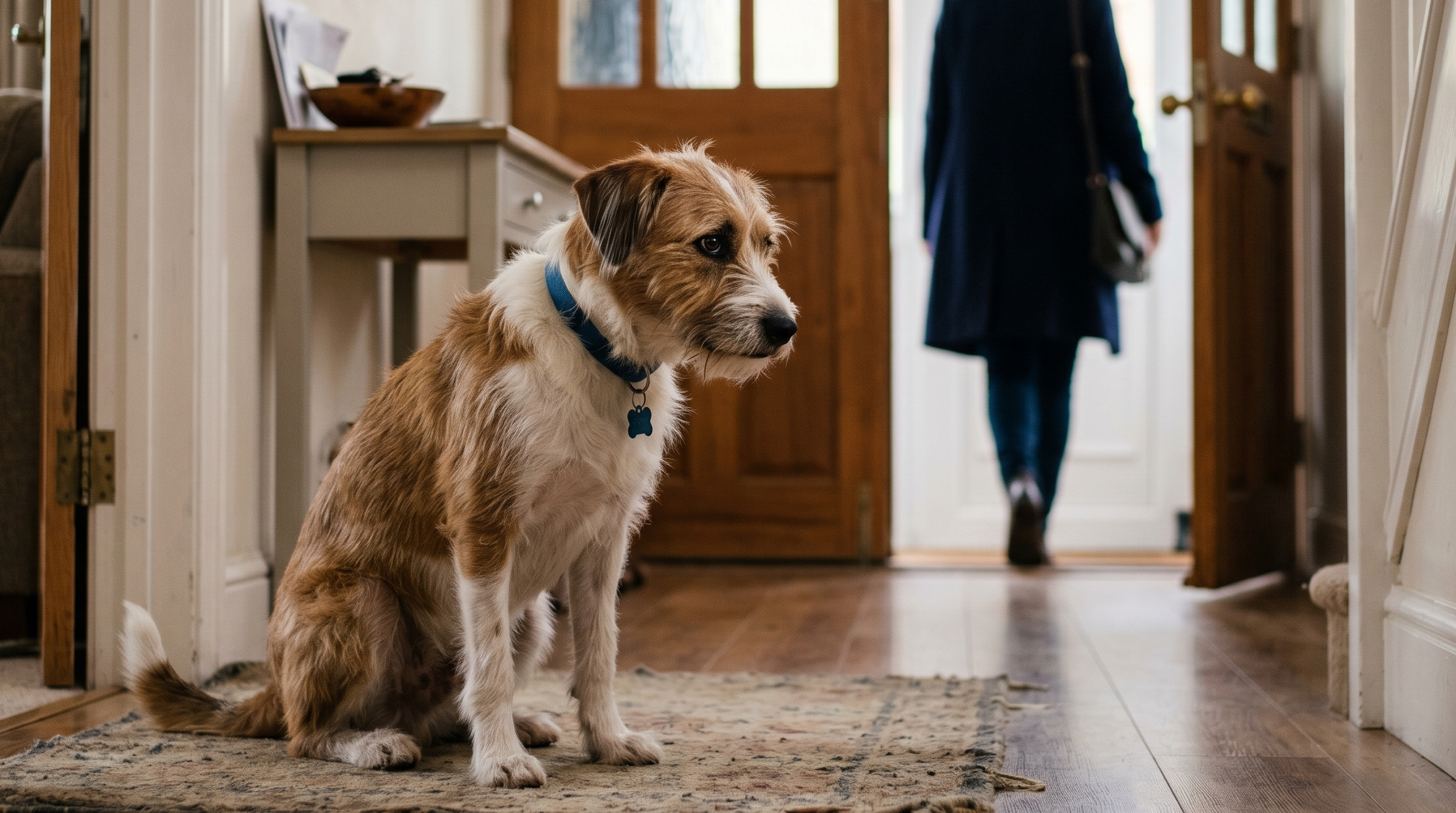
The first time I left Mochi alone in our new apartment, I made it approximately forty steps down the hallway before I heard her.
Not barking. Screaming. The kind of sound that made my neighbor open her door and look at me with an expression somewhere between concern and accusation. I turned around and went back inside. Mochi was pressed against the door, shaking, with a look on her face that I can only describe as pure betrayal.
That was the beginning of eight months that I now think of as “the separation anxiety years.” What I didn’t know then, standing in that hallway, was that what we were dealing with had a name, a body of research, and — eventually — a solution. What I also didn’t know was how much wrong advice I was about to follow before finding the right kind.
This is the account I wish I’d been able to read at the beginning. The honest one, not the one that makes it sound simpler than it is.
Chapter 1 – understanding what we were actually dealing with
For the first few weeks, I told myself Mochi was just “adjusting.” She was a rescue — a two-year-old mixed breed I’d adopted three months earlier — and I assumed some settling-in period was normal. When the behavior didn’t improve, I started Googling. That’s when I first encountered the term dog separation anxiety, and felt that particular sensation of recognition that comes with putting a name to something you’ve been living with.
Separation anxiety in dogs is a specific anxiety disorder, not a personality quirk or a training gap. It’s characterized by genuine panic — not discomfort, not boredom, but panic — that occurs specifically in response to the departure or absence of the dog’s primary attachment person. The operative word is “specific”: a dog with true separation anxiety can often manage just fine in doggy daycare, or with a pet sitter, because the problem isn’t being alone. The problem is you leaving.
This distinction confused me for a long time. Mochi was fine at the dog park without me hovering nearby. She was fine in the vet’s waiting room when I stepped outside to take a phone call. The problem was exclusively triggered by me picking up my keys and walking out of our apartment. It felt personal, because in a way it was — she had attached deeply to me, and my departures felt to her like something genuinely threatening.
“The problem isn’t being alone. The problem is you leaving.”
Getting a proper diagnosis was the first useful thing I did. My vet confirmed what I suspected, referred me to a veterinary behaviorist for an initial consultation, and — importantly — set up a camera so I could actually watch what happened after I left. What I saw on that footage changed my approach entirely: Mochi didn’t settle after ten minutes the way I’d hoped. She paced at the door for the full hour I was gone, pausing only occasionally to drink water. The distress was real and sustained, not performative.
Chapter 2 – The advice that didn’t work
Before I found an approach that actually helped, I spent a good two months following advice that was either wrong or incomplete. I’m including this part because I’ve since spoken to dozens of other owners dealing with separation anxiety in dogs, and almost all of them went through the same wrong turns. Knowing what doesn’t work saves time.
“Just ignore it and she’ll figure out you always come back.” This is the most common piece of well-meaning bad advice. Extinction — letting the dog work through the distress without intervention — doesn’t work for true separation anxiety the way it might work for attention-seeking barking. Panic isn’t something dogs “work through.” Every departure that triggers a full panic response reinforces the neural pathway that says “departure = crisis.” I ignored it for three weeks and Mochi got worse, not better.
“Give her more exercise so she’s tired when you leave.” Exercise is genuinely important — I’ll come back to this — but it doesn’t fix separation anxiety. I was taking Mochi on ninety-minute walks every morning before work. She was physically exhausted and still spiraling the moment I left. Exercise addresses arousal level, not the underlying fear.
“Don’t comfort her when she’s anxious, you’ll reinforce it.” This one bothered me the most, because it went against every instinct and also, it turns out, against what the research actually shows. You can reinforce behaviors. You can’t reinforce emotional states. Fear is a physiological response, not a behavior your dog is producing to get a reward. Calm reassurance doesn’t amplify fear. What does amplify it is emotional, high-pitched comforting from an owner who is themselves distressed — because dogs read your emotional state and use it as information about whether something is actually dangerous.
Chapter 3 – What the actual training looks like
The approach that eventually worked is called graduated departure training combined with counter-conditioning. I want to describe what it actually looked like in practice, because most descriptions of it make it sound cleaner and faster than it is.
The principle is simple: you teach your dog that departures are safe by starting with departures so short they can’t trigger a panic response, and building up from there one tiny increment at a time. You’re not just building tolerance — you’re actively changing the emotional association with departure, from “threat” to “unremarkable event that always ends in return.”
In practice, this meant I started by walking to my front door and coming back. Not opening it. Just walking to it, turning around, walking back, giving Mochi a treat. I did this about twenty times in a row the first session. Then I walked to the door, touched the handle, walked back. Then I opened it briefly and closed it. Then I stepped outside for three seconds.
Three seconds. That was the first “successful absence” — three seconds outside the door, back inside, treat, calm greeting. I did this multiple times a day for a week before I extended to ten seconds.
I am not going to pretend this wasn’t deeply tedious. It was. The pace felt absurd — like training for a marathon by lifting one finger. But the logic is sound: every practice at a level where Mochi didn’t panic was a repetition that said “departure is safe.” Every practice that triggered panic was a repetition that said the opposite. Progress required staying below the threshold, which meant moving slower than felt reasonable.
The other thing that made an enormous difference was the frozen Kong. Every time I left — exclusively then, never at any other time — Mochi got a Kong stuffed with peanut butter and frozen the night before. Within about three weeks, she started showing something that looked almost like anticipation when I picked up my keys. The emotional association was beginning to shift: my departure was starting to predict the best thing that happened to her all day.
Chapter 4 – The thing nobody told me about the schedule
Here is the part that took me the longest to understand, and the part I now think is the most important: you cannot make meaningful progress on dog separation anxiety training while simultaneously leaving your dog alone for eight hours every workday.
Every morning departure that triggered full panic was undoing, in eight hours, what I’d built in the previous evening’s practice sessions. I was training two steps forward every night and leaving two steps back every morning. The net progress was approximately zero.
This is the part of the problem that nobody warns you about, because solving it requires something that isn’t a training technique — it requires rearranging your life, at least temporarily. In my case, that meant three months of doggy daycare on weekdays (expensive), working from home two days a week (lucky that this was possible), and recruiting my neighbor to check in on Mochi on the remaining days. The goal was simple: Mochi should never be left alone for longer than her current comfortable threshold during the training period.
For the first six weeks, that threshold was about twelve minutes. For the next six weeks, it stretched to about forty-five. By month four, she could manage two hours. By month seven, four hours was mostly fine.
“Training two steps forward every night, leaving two steps back every morning. The net progress was zero.”
Chapter 5 – The month I nearly gave up
Around the three-month mark, Mochi had a terrible week. I’d thought we were making real progress — she’d been managing 45-minute absences fairly consistently — and then, seemingly out of nowhere, she regressed to day-one levels of distress. Full panic at the door. Neighbor complaints again. One morning I sat on the floor outside my apartment and cried a little, which felt embarrassing and also completely warranted.
What I later understood was that this was a normal feature of separation anxiety recovery, not a sign of failure. Setbacks during separation anxiety treatment in dogs are almost universal, and they often happen right after a period of apparent progress. The nervous system doesn’t update in a straight line. A stressful week — Mochi had had a vet visit and a thunderstorm within three days — can temporarily reset the baseline even after genuine improvement has occurred.
This is the point at which I finally called the veterinary behaviorist my vet had recommended, and asked about medication. I’d been resistant to it — some combination of feeling like it was cheating and worrying about side effects. The behaviorist was direct with me: “You’ve been at this for three months with inconsistent results. The anxiety may be too high for the training to reliably accumulate. Medication isn’t giving up. It’s what makes giving up unnecessary.”
We started Mochi on fluoxetine (Reconcile) — the only medication FDA-approved specifically for dog separation anxiety. It takes four to six weeks to reach full effect. For the first six weeks I noticed nothing. Then, gradually, something shifted. Not that Mochi became a different dog — she didn’t. But her baseline seemed lower. The spikes when they happened were shorter. The training started to stick in a way it hadn’t quite managed before.
I want to say clearly: the medication didn’t fix the separation anxiety. The training fixed it. The medication made it possible for the training to work. That’s a meaningful distinction, and it’s what changed my mind about it.
Chapter 6 – What our life looks like now
Mochi is four years old. She can be left alone for six hours without significant distress — I know this because I still check the camera occasionally, and what I mostly see is sleeping. She still needs her morning walk before I leave. She still gets a frozen Kong. When I pick up my keys, she trots over to her bed, which is where she waits for the Kong rather than standing at the door.
Is she “cured”? I’m not sure that’s the right word. She still does better when my schedule is predictable. A disrupted week — travel, unusual hours — takes a few days to recover from. She will probably always need some management that a dog without this history wouldn’t. That’s fine. It’s a small price for a dog who can now actually rest when I’m gone, rather than spending every absence in a state of panic.
What I know, looking back, is that the eight months felt enormous from the inside and feel proportionate from the outside. The things that actually mattered were: a correct understanding of what we were dealing with, a willingness to move slower than felt reasonable, a temporary rearrangement of our schedule, and eventually medication that gave the training room to work. Everything else was noise.
The short version of what worked
Camera first. Know what you’re actually dealing with before you do anything else.
Departure cues before departures. Desensitize to keys, shoes, and coat before working on the door.
Frozen Kong exclusively at departure. Exclusivity is what builds the positive association.
Never exceed the comfortable threshold during training. Panic during absences undoes practice. Arrange coverage if you need to.
Consider medication earlier than feels comfortable. If training isn’t sticking after 6–8 weeks of consistency, medication isn’t cheating. It’s what makes progress possible.
Expect setbacks and plan for them. A bad week after a period of progress is normal, not failure. The baseline trajectory still matters.