
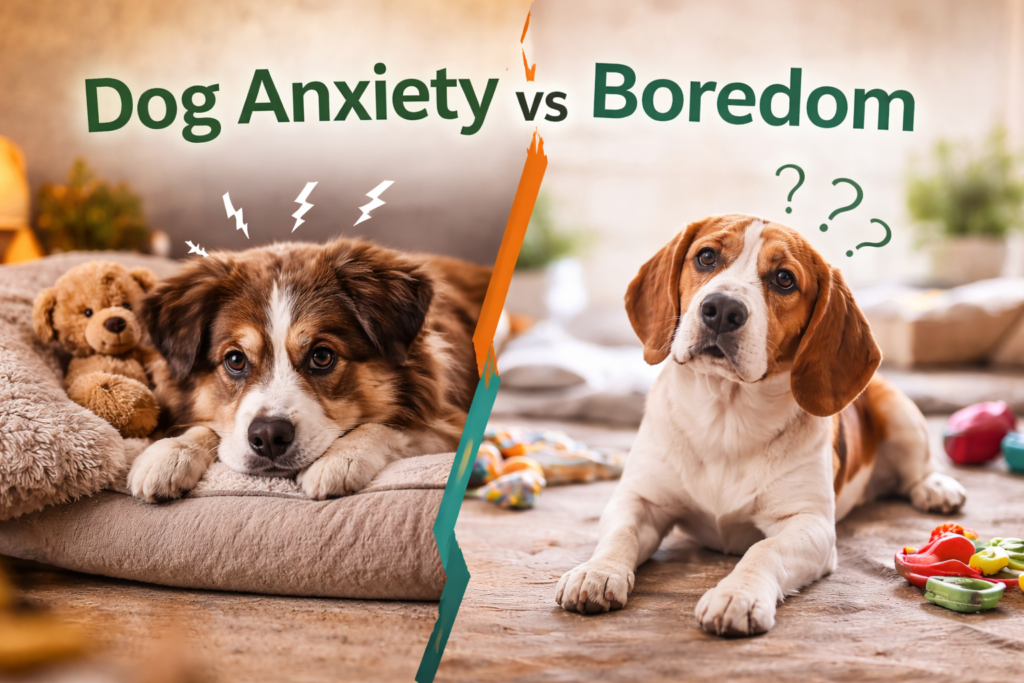
It’s easy to get this wrong
A dog that chews furniture.
A dog that paces around the house.
A dog that won’t settle down.
Most owners see these behaviors and assume one thing:
“My dog is anxious.”
But that’s not always true.
In fact, a large number of behavior issues that look like anxiety are actually caused by something much simpler — boredom.
And if you misread the cause, you’ll apply the wrong solution.
Why the difference matters more than you think
At a glance, anxiety and boredom can look very similar.
Both can lead to:
- Restlessness
- Destructive behavior
- Excessive movement
- Attention-seeking
But the internal state of the dog is completely different.
👉 Anxiety is driven by stress and uncertainty
👉 Boredom is driven by lack of stimulation
Treating boredom like anxiety can make a dog frustrated.
Treating anxiety like boredom can make a dog overwhelmed.
That’s why understanding the difference is so important.
The key question: what is driving the behavior?
Before looking at specific signs, it helps to ask one simple question:
Is the dog trying to release energy, or escape stress?
This alone can often point you in the right direction.
Signs your dog is dealing with boredom
Dogs that are bored tend to show behaviors that are active and exploratory.
You might notice:
- Random chewing (not focused on doors or exits)
- Digging, tearing, or shredding objects
- High energy bursts
- Constant attention-seeking
- Following you around out of stimulation, not fear
A bored dog often looks like it’s “looking for something to do.”
They are not necessarily stressed — they are under-stimulated.
A typical boredom pattern
A dog sleeps most of the day.
Gets little structured activity.
Then suddenly becomes hyper in the evening.
This is not anxiety — it’s a lack of physical and mental outlets.
Signs your dog is experiencing anxiety
Anxious behavior has a different tone.
Instead of random activity, it tends to be focused and repetitive.
You may see:
- Pacing the same path repeatedly
- Fixating on doors or windows
- Whining without clear cause
- Refusing to settle even when tired
- Signs of tension (panting, shaking, alert posture)
An anxious dog isn’t looking for something to do.
They’re trying to cope with a feeling they don’t understand.
A typical anxiety pattern
A dog becomes restless when you prepare to leave.
Follows you closely.
Becomes distressed once alone.
This is not excess energy — it’s separation-related stress.
Where people get confused
The confusion usually comes from overlapping behaviors.
For example:
- Chewing can be boredom OR anxiety
- Pacing can be excitement OR stress
- Barking can be attention-seeking OR fear
So the behavior itself is not enough.
👉 You need to look at context and timing
Context matters more than behavior
Instead of asking:
“What is my dog doing?”
Ask:
“When and why is my dog doing this?”
Example 1
Dog chews shoes when left alone
→ Likely anxiety
Example 2
Dog chews random objects when you’re home
→ Likely boredom
Example 3
Dog runs around after being inactive all day
→ Boredom
Example 4
Dog paces at night despite exercise
→ Possible anxiety
What happens when you get it wrong
This is where things start to go downhill.
If you treat boredom as anxiety
You might:
- Restrict movement
- Over-control the environment
- Reduce activity
👉 Result: frustration increases
If you treat anxiety as boredom
You might:
- Add more stimulation
- Increase activity
- Introduce too many new inputs
👉 Result: the dog becomes more overwhelmed
How to respond correctly
If it’s boredom
Focus on:
- Physical exercise
- Mental stimulation
- Structured activities
Give your dog something to do.
If it’s anxiety
Focus on:
- Reducing stress triggers
- Creating predictable routines
- Gradual exposure training
Help your dog feel safe.
When it’s both
In many cases, it’s not one or the other.
A dog can be:
- Under-stimulated during the day
- And anxious at certain times
This combination is actually very common.
In this case
You need a balanced approach:
- Increase structured activity
- Reduce stress triggers
- Avoid overstimulation
A simple way to test
If you’re unsure, try this:
👉 Give your dog a mentally engaging activity (like a scent-based task)
Then observe:
- If they relax → boredom was likely a factor
- If they stay tense → anxiety is more likely
Final thought
Most dog behavior problems are not random.
They follow patterns.
And once you understand what’s driving those patterns — boredom or anxiety — the solution becomes much clearer.
Getting this distinction right is one of the most important steps in helping your dog live a calmer, more balanced life.