
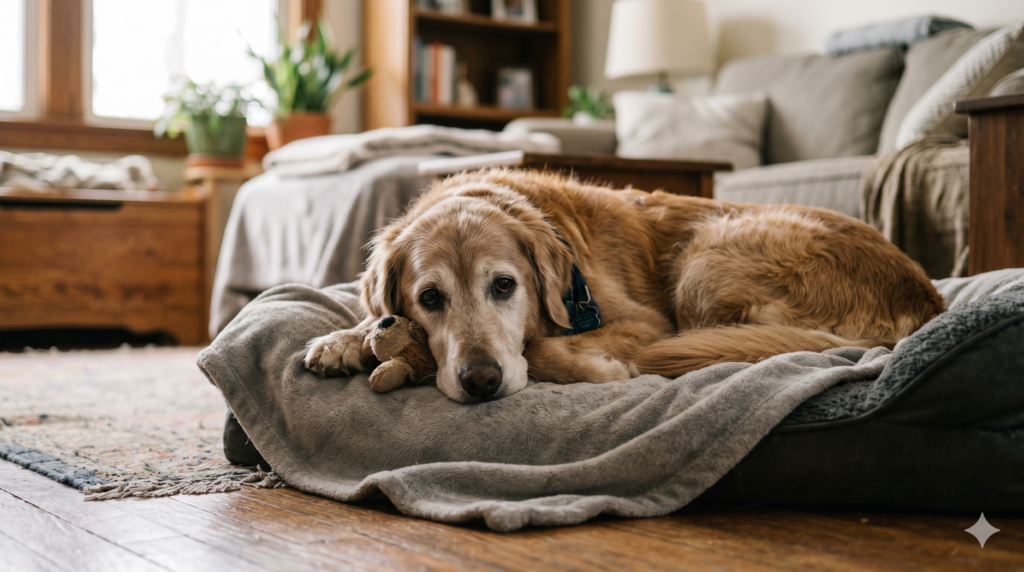
Your dog has been calm and settled for ten years. Then, somewhere around their twelfth birthday, things start to shift. Restlessness at night. Pacing in rooms they used to be comfortable in. Startling at sounds they never noticed before. Clinginess that wasn’t there before. A general sense of unease that you can’t quite explain.
Senior dog anxiety is one of the most common — and most commonly misunderstood — issues in geriatric dog care. It’s frequently dismissed as “just getting old” or assumed to be a behavioral problem that needs training. In most cases, it’s neither. It’s a medical issue that needs diagnosis and treatment.
Understanding why your older dog has become anxious is the most important step toward helping them.
In this guide
- Why senior dog anxiety is different
- How common is it?
- The main causes — medical first
- Canine cognitive dysfunction explained
- Recognizing anxiety in senior dogs
- Treatment: medical and behavioral
- Environmental changes that help
- Supplements and products
- Frequently asked questions
Why Senior Dog Anxiety Is Different
Anxiety guides written for younger dogs focus on socialization gaps, traumatic experiences, and behavioral training protocols. Most of that doesn’t apply to anxiety in older dogs — and applying it anyway wastes time and, more importantly, delays getting to the actual cause.
When a young dog develops anxiety, the first question is: what happened, and what has this dog learned to be afraid of? When a senior dog develops anxiety — especially if it appears gradually or suddenly in a dog that was previously settled — the first question is: what has changed medically?
This reframe matters because the treatments are completely different. Behavioral desensitization training, which is the core intervention for fear-based anxiety in younger dogs, does very little for anxiety that stems from cognitive decline or chronic pain. What those conditions need is medical management, environmental adaptation, and in some cases, medication specifically targeted at the underlying cause.
The most important rule for senior dog anxiety: Rule out medical causes before assuming behavioral ones. A vet visit with bloodwork, a pain assessment, and ideally a cognitive function screening is the right starting point — not a training protocol.
How Common Is It?
- 28% of dogs aged 11–12 show signs of cognitive dysfunction
- 68% of dogs aged 15–16 are affected by canine cognitive dysfunction
- 50% of CDS cases go undiagnosed because symptoms are mistaken for “normal aging”
These numbers come from multiple peer-reviewed studies on canine cognitive dysfunction syndrome (CDS), the neurological condition most closely associated with senior dog anxiety. The prevalence data is striking — and the underdiagnosis rate is arguably more important than the prevalence itself. If half of affected dogs aren’t being identified, most of them aren’t being treated.
Anxiety specifically — as a symptom of cognitive decline — is present in an estimated 49% of dogs with CDS, making it one of the most common manifestations of the condition alongside disorientation and sleep disruption.
The Main Causes of Anxiety in Senior Dogs
Understanding the cause of your dog’s anxiety determines the treatment. These are the most common causes, roughly in order of frequency:
1. Canine cognitive dysfunction syndrome (CDS)
The most common cause of new-onset anxiety in dogs over 10. Progressive neurological changes affect memory, spatial awareness, and sleep regulation — all of which contribute to anxiety and restlessness. See the dedicated section below for full detail.
2. Chronic pain
Arthritis affects the majority of dogs over 8 years old to some degree, and it is a significant driver of anxiety and behavioral changes. A dog in constant discomfort sleeps poorly, startles more easily, snaps when touched in painful areas, and may become generally irritable or clingy. Pain is frequently under-recognized in dogs because they are stoic — behavioral changes are often the primary signal.
3. Hearing loss
Age-related hearing loss (presbycusis) is extremely common in older dogs and directly causes anxiety. A dog that can no longer hear you approaching startles when you appear. A dog that can’t localize sounds becomes generally hypervigilant. Many owners attribute the resulting anxiety to stubbornness or behavioral deterioration without realizing their dog simply can’t hear.
4. Vision loss
Progressive retinal atrophy, cataracts, and other age-related vision changes reduce a dog’s ability to navigate their environment confidently. Anxiety tends to worsen in low light conditions (when even partial vision loss becomes more impairing) and in unfamiliar spaces. A previously bold dog that becomes reluctant to move around the house in the evening is often showing vision-related anxiety.
5. Thyroid and other endocrine changes
Hypothyroidism is common in older dogs and can present with anxiety, restlessness, and behavioral changes alongside physical symptoms. Cushing’s disease (hyperadrenocorticism) similarly affects behavior. Both are diagnosable through bloodwork and highly treatable — which is why baseline bloodwork in a senior dog with new anxiety is non-negotiable.
6. Neurological conditions
Brain tumors, vestibular disease, and other neurological conditions can cause anxiety as a symptom. These are less common than the above but important to rule out, particularly when anxiety is accompanied by head tilting, circling, sudden onset, or other neurological signs.
When anxiety appears suddenly in a previously calm older dog: Sudden-onset anxiety is a red flag for an acute medical issue — vestibular event, pain flare, neurological change. It warrants a same-day vet visit rather than a “wait and see” approach.
Canine Cognitive Dysfunction Syndrome — The Full Picture
Canine cognitive dysfunction syndrome (CDS) is the condition most people are referring to when they talk about “doggy dementia,” though it more closely resembles Alzheimer’s disease at the neurological level. It’s caused by the accumulation of beta-amyloid plaques in the brain — the same pathological process seen in human Alzheimer’s — alongside oxidative damage and reduced cerebral blood flow.
CDS is progressive and currently has no cure. However, it is highly manageable, and early intervention can slow progression and significantly improve quality of life. The most important thing to understand about CDS is that the behavioral changes it causes — including anxiety — are symptoms of a medical condition, not personality changes or training failures.
The DISHA framework for recognizing CDS
Veterinarians use the acronym DISHA to describe the symptom clusters of canine cognitive dysfunction:
| Letter | Symptom cluster | What it looks like |
|---|---|---|
| D | Disorientation | Getting “stuck” in corners, staring at walls, appearing lost in familiar spaces, not recognizing familiar people |
| I | Interactions changed | Reduced interest in play or social contact, or conversely, increased clinginess and anxiety when separated |
| S | Sleep-wake cycle disruption | Sleeping during the day, awake and restless at night, pacing, vocalization at night |
| H | House soiling | Accidents in a previously house-trained dog, apparently forgetting toilet routines |
| A | Activity changes | Reduced activity and responsiveness, increased repetitive behaviors, anxiety, restlessness |
Anxiety falls primarily under the I and A categories — but the sleep disruption (S) is also tightly linked, because a dog that cannot sleep becomes progressively more anxious during waking hours. Treating the sleep disruption often significantly reduces the daytime and evening anxiety.
The CDS-anxiety connection: Many owners seeking help for what appears to be separation anxiety or generalized anxiety in their senior dog are actually dealing with CDS. The distinction matters because the treatment is different: behavioral training has limited impact on CDS-driven anxiety, while medical management and environmental adaptation can be highly effective.
Recognizing Anxiety in Senior Dogs
Some symptoms of anxiety in older dogs overlap with younger dogs. Others are specific to the senior population or take on a different character in older animals.
Behavioral signs
- Increased clinginess or shadowing
- Restlessness — unable to settle
- Pacing, especially at night
- Increased vocalization (whining, howling at night)
- Startling more easily
- Reduced tolerance for alone time in a previously independent dog
- Repetitive behaviors (circling, licking)
Physical signs
- Panting without physical exertion or heat
- Trembling or shaking
- Loss of appetite during anxious periods
- Gastrointestinal upset
- Dilated pupils
- Increased shedding during stressful events
CDS-specific signs
- Anxiety specifically at dusk/”sundowning”
- Getting stuck in corners or behind furniture
- Not recognizing familiar family members
- Staring blankly at walls or into space
- House soiling without apparent physical cause
Pain-related signs
- Snapping when touched in specific areas
- Reluctance to lie down or rise
- Anxiety that worsens after activity
- Changes in posture or gait alongside anxiety
- Decreased interest in food (pain suppresses appetite)
“Sundowning” in senior dogs: Many dogs with CDS show markedly increased anxiety in the late afternoon and evening — a pattern called sundowning, also seen in human Alzheimer’s patients. If your dog is relatively calm during the day but becomes restless, vocal, or disoriented as evening approaches, CDS is the most likely explanation.
Treatment: Medical First, Then Behavioral
The treatment approach for senior dog anxiety is fundamentally different from younger dogs, and the order matters. Medical causes should be identified and addressed before behavioral interventions are layered on top — not because behavioral support isn’t helpful, but because it has limited effect on anxiety driven by an untreated medical condition.
Step 1 — Veterinary assessment
1. Complete health workup
The minimum for a senior dog presenting with new anxiety: full bloodwork (CBC, chemistry panel, thyroid function), urinalysis, blood pressure check, pain assessment, and a cognitive function screening. Many vets use validated tools like the Canine Cognitive Dysfunction Rating Scale or the CADES questionnaire. These take minutes and can make the difference between treating the right thing and not.
2. Address pain if present
If arthritis or another pain condition is identified, treating the pain often produces dramatic improvement in anxiety with no other intervention needed. NSAIDs, gabapentin, and newer pain management options like grapiprant (Galliprant) have all shown significant effects on quality of life and behavioral wellbeing in senior dogs. A dog that’s no longer in constant pain can finally relax.
3 CDS-specific medication
Selegiline (Anipryl) is the only medication FDA-approved specifically for canine cognitive dysfunction. It works by increasing dopamine levels in the brain and has shown improvement in multiple CDS symptoms including anxiety, disorientation, and sleep disruption in clinical studies. It takes 4–8 weeks to reach full effect. Not appropriate for all dogs — your vet will assess suitability.
4.Anxiety-specific medication if needed
For anxiety that persists after pain management and CDS treatment, or in dogs without CDS whose anxiety has a fear-based component, additional options include trazodone (situational), gabapentin (also addresses pain), and in some cases fluoxetine for generalized anxiety. Dosing in senior dogs requires careful consideration of liver and kidney function — the same dose that works in a younger dog may be too much for an older one.
Behavioral and environmental support
Once medical causes are being managed, behavioral and environmental support significantly improves outcomes. Unlike with younger dogs, the goal here isn’t training — it’s reducing environmental demands and increasing predictability and comfort.
- Maintain rigid routine — predictability is more important for senior dogs with CDS than for any other population. Same feeding time, same walk time, same sleeping arrangement. Disruptions to routine cause disproportionate anxiety in cognitively declining dogs.
- Increase nighttime support — for dogs with nighttime restlessness, moving their sleeping area closer to you, using a night light (for dogs with vision loss), and adding white noise can all reduce nighttime anxiety episodes.
- Reduce environmental complexity — a senior dog with CDS navigates their world less well than they used to. Reducing clutter, keeping furniture arrangements consistent, and using baby gates to limit access to areas where the dog gets confused all reduce anxiety by reducing the opportunities for disorientation.
- Gentle, low-demand enrichment — sniff walks, lick mats, and slow food puzzles provide mental stimulation without physical or cognitive overload. Keep sessions short — 5 to 10 minutes.
- More frequent, shorter owner interaction — many senior dogs with anxiety benefit from more frequent brief check-ins rather than long periods of independence followed by extended interaction. Ten two-minute interactions throughout the day is more reassuring for an anxious senior dog than one extended cuddle session.
Environmental Changes That Make a Real Difference
These are the modifications that consistently improve quality of life for anxious older dogs — and most of them cost little or nothing:
For dogs with hearing loss
- Approach from the front, or stomp lightly to create floor vibrations before getting close
- Use hand signals alongside verbal cues (or transition entirely to hand signals)
- Touch them gently in the same spot to signal your approach
- Avoid waking them suddenly — a startled deaf dog may snap reflexively
- Consider a vibrating collar (not shock — vibration only) as a recall signal
For dogs with vision loss
- Keep furniture in consistent positions — rearranging the house is disorienting
- Use night lights in key areas
- Alert them verbally before touching
- Keep their food, water, and bed in the same locations
- Consider scent markers (a drop of lavender near the water bowl, for example) to help with navigation
For dogs with CDS-related nighttime anxiety
- White noise machine near sleeping area masks sudden sounds that trigger waking
- Consistent bedtime and wake time — even small variations disrupt already-fragile circadian rhythms
- Keep sleeping area well-lit enough to reduce disorientation when they wake
- A worn item of your clothing in their sleeping area provides olfactory comfort
- Consider melatonin (discussed below) specifically for sleep-wake cycle support
Supplements and Products for Senior Dog Anxiety
For senior dog anxiety, the supplement landscape is somewhat different from younger dogs. Some options that work well in younger anxious dogs have limited relevance here; others are specifically valuable for the aging brain.
Important for senior dogs: Always check with your vet before adding any supplement to an older dog’s regimen. Drug interactions are more common in senior dogs (who are often on multiple medications), and liver or kidney function changes can affect how supplements are metabolized. “Natural” does not mean “safe at any dose in any dog.”
Melatonin — specifically for sleep and CDS
Melatonin is particularly valuable for senior dogs with anxiety because it addresses one of the key drivers of CDS-related anxiety: disrupted circadian rhythm. Supplemental melatonin helps regulate sleep-wake cycles, which reduces nighttime restlessness and the daytime anxiety that follows from poor sleep.
Best for nighttime anxiety
Zesty Paws Calming Bites with Melatonin
Melatonin combined with L-theanine and chamomile. Give 30–60 minutes before your dog’s usual bedtime. Particularly effective for the nighttime restlessness and pacing pattern in dogs with CDS. Start with the lowest dose for your dog’s weight. Do not use products containing xylitol — always check the ingredients.See current price →
Omega-3 fatty acids — for cognitive support
EPA and DHA (the active forms of omega-3) have the strongest evidence base of any supplement for canine cognitive dysfunction. Multiple studies show that omega-3 supplementation in senior dogs improves cognitive test performance and is associated with slower progression of CDS. The mechanism is anti-inflammatory — omega-3s reduce neuroinflammation that contributes to cognitive decline.
Best evidence base
Nordic Naturals Omega-3 Pet
High-quality EPA/DHA from anchovy oil, third-party tested for purity. The evidence for fish-derived omega-3 in dogs is substantially stronger than plant-derived sources. Dose by weight — veterinary guidelines suggest 50–75mg EPA/DHA per kg of body weight daily for therapeutic effect. Takes several weeks to show benefit.See current price →
L-theanine — for general anxiety reduction
L-theanine is appropriate for senior dogs with anxiety, has no significant drug interactions, and is well-tolerated in older animals. It works by modulating glutamate receptors involved in the stress response — reducing anxiety without sedation or respiratory effects.
Safest OTC option
Solliquin Soft Chews
Veterinary-formulated with L-theanine and magnolia/phellodendron extract. One of the few OTC calming products specifically studied in dogs with clinical anxiety in a controlled trial. Appropriate for long-term use in senior dogs. Available through vets and pet pharmacies.See current price →
SAMe and MCT oil — emerging cognitive support
S-adenosylmethionine (SAMe) has some evidence for cognitive support in senior dogs and is sometimes recommended alongside selegiline for CDS. Medium-chain triglyceride (MCT) oil provides an alternative fuel source for neurons and has shown cognitive benefit in older dogs in preliminary studies. Neither is a replacement for veterinary-prescribed CDS treatment, but both are reasonable adjuncts to discuss with your vet.
Adaptil diffuser
The dog-appeasing pheromone released by Adaptil is particularly relevant for senior dogs because it taps into a deeply hardwired calming signal that doesn’t depend on cognitive processing — useful for dogs whose cognitive decline makes other reassurance signals less effective.
When to Prioritize Veterinary Behavioral Specialist Referral
Most senior dog anxiety can be managed by your regular vet with the right workup and treatment plan. Referral to a veterinary behaviorist (DACVB) is warranted when:
- Anxiety is severe and significantly impairs quality of life despite standard treatment
- Multiple medications have been tried without adequate response
- The anxiety pattern is unusual or doesn’t fit standard presentations
- You want an expert opinion on the most current evidence-based approach to CDS management
Veterinary behaviorists have specific expertise in psychopharmacology in senior animals and are updated on emerging treatments — including some that may not yet be widely known to general practice vets. Given the stakes for quality of life in an older dog, that expertise is often worth seeking out.
Frequently Asked Questions
Why is my old dog suddenly anxious when they were never anxious before?
New anxiety in a previously settled older dog is almost always medical in origin. The most common causes are canine cognitive dysfunction syndrome, chronic pain (especially arthritis), hearing or vision loss, and thyroid or other endocrine changes. A vet visit with bloodwork is the right first response — this is not a training problem and should not be approached as one. Early diagnosis and treatment of the underlying cause can make a dramatic difference.
Is pacing at night normal for older dogs?
No. Nighttime pacing in older dogs is a clinical symptom — most commonly of canine cognitive dysfunction syndrome or pain — not a normal part of aging. It’s one of the most common reasons senior dogs are presented to vets for behavioral concerns. Both causes are treatable. A dog that paces at night is a dog in distress, and that distress has a cause worth finding and addressing.
Can dementia cause anxiety in dogs?
Yes — anxiety is one of the most common symptoms of canine cognitive dysfunction syndrome (the dog equivalent of dementia). An estimated 49% of dogs with CDS show significant anxiety symptoms. The mechanism is multifactorial: disorientation creates direct fear, disrupted sleep causes accumulated stress, and neurological changes affect the brain’s ability to regulate the anxiety response. Treating the CDS directly — with selegiline and cognitive support — usually improves anxiety symptoms significantly.
How do I know if my dog’s anxiety is from pain or cognitive decline?
This is genuinely difficult to distinguish without veterinary assessment, because the symptoms overlap considerably. Some useful differentiators: pain-related anxiety tends to worsen after activity and is often accompanied by changes in posture, gait, or reaction to touch. CDS-related anxiety tends to follow a circadian pattern (worse in the evening), includes disorientation and house soiling, and is not directly related to physical activity. In practice, many senior dogs have both, and addressing pain often reveals what proportion of the anxiety is cognitive in origin.
My senior dog has started having accidents inside — is that anxiety?
House soiling in a previously trained older dog can be anxiety-related (specifically CDS), but it can also be caused by urinary tract infections, incontinence, kidney disease, or other medical conditions. Don’t assume anxiety without ruling out physical causes first. CDS-related house soiling typically occurs because the dog forgets toilet training or doesn’t register the need to go outside — it’s usually distinguished by the dog seeming unaware of the accident rather than embarrassed by it.
What’s the best thing I can do for my anxious senior dog right now?
Book a vet appointment. Not next month — soon. The most impactful thing you can do is get a proper diagnosis. If the cause is pain, treating it often produces rapid and significant improvement. If it’s CDS, starting selegiline early slows progression. If it’s thyroid or another endocrine issue, treatment is often highly effective. The single biggest mistake owners make with senior dog anxiety is waiting too long and accepting decline as inevitable when it’s often both diagnosable and treatable.
Pingback: French Bulldog Anxiety: Causes, Signs & What Actually Helps (2026)
Pingback: Dog Separation Anxiety: Real Answers to the Questions (2026)
Pingback: Dog Car Anxiety: Causes, Symptoms & What Actually Helps (2026)