
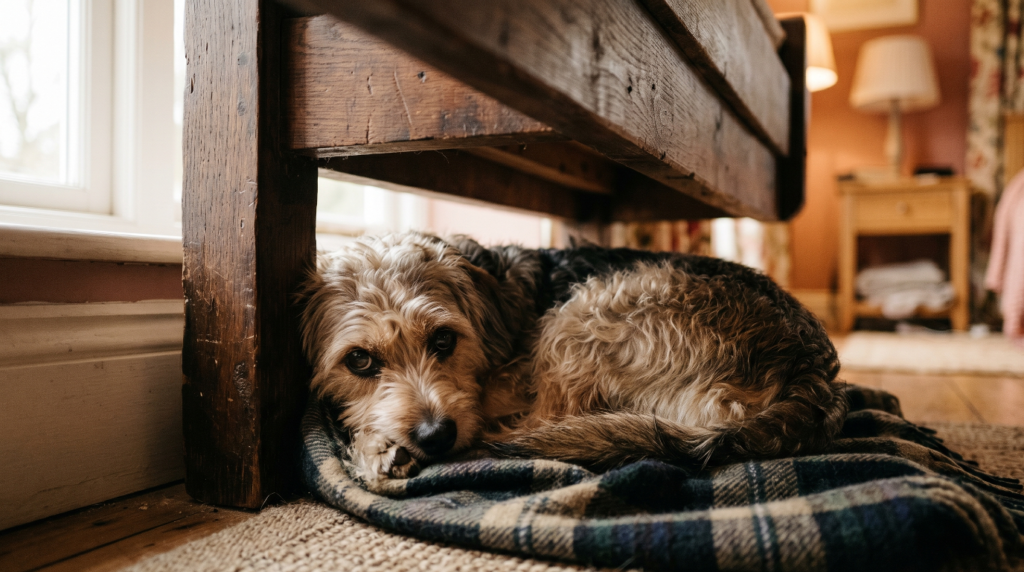
My first dog, Biscuit, was a beagle mix I adopted at four months old. Sweet dog. Completely lost his mind over plastic bags.
Not aggressive — just terrified. A grocery bag rustling in the next room would send him cowering under the bed for twenty minutes. It took me an embarrassingly long time to realize this wasn’t just “quirky beagle behavior.” He was showing signs of anxiety — and I had no idea what to do about it.
If your dog is afraid of everything — sounds, strangers, other dogs, their own shadow — you’re not alone. What looks like a dog that’s simply “jumpy” is often a dog dealing with underlying anxiety. Understanding the difference changes how you respond, and how much progress you can actually make.
IN THIS GUIDE
- Fear vs. anxiety: why the difference matters
- Is your dog jumpy, or actually scared?
- Why is my dog scared of everything? The real reasons
- Skittish vs. fearful: what’s the difference?
- How to tell if your dog is scared (vs. sick or in pain)
- What actually helps — and what doesn’t
- A note on puppies and fear periods
- Products worth considering
- Common questions
Fear vs. Anxiety — Why the Difference Matters
Most people use “scared” and “anxious” interchangeably when describing their dog. For practical purposes they’re related — but they’re not the same thing, and the distinction actually changes what you should do about it.
Fear is a response to something specific and present: a thunderclap, a stranger at the door, a trip to the vet. It’s acute. Once the trigger is gone, a non-anxious dog settles back down relatively quickly.
Anxiety is different. It’s a state of anticipatory worry that doesn’t need a trigger in the room. An anxious dog isn’t just reacting — they’re expecting something bad to happen. They scan for threats even when everything is calm. That’s why a dog with anxiety can seem scared of everything: the threat isn’t a specific thing, it’s the world in general.
ON THIS SITE
A dog scared of everything is often showing signs of generalized dog anxiety — a condition that goes beyond individual fears and affects a dog’s baseline state. If your dog’s fearfulness feels pervasive rather than triggered by specific things, that’s the more useful frame for understanding what’s going on.
We cover the full picture — causes, types, and treatment — in our complete dog anxiety guide →
Is Your Dog Actually Scared, or Just Jumpy?
There’s a difference between a dog that’s jumpy and scared in a reactive, in-the-moment way, and one that lives with a constant low hum of anxiety. Both are worth addressing, but they look different and need different approaches.
A jumpy dog might startle at a loud noise and shake it off in thirty seconds. A dog that’s truly scared of everything stays in a heightened state — scanning the room, refusing to eat, unable to settle even after the threat is long gone.
Signs your dog is genuinely scared, not just startled:
- Tucked tail, hunched posture, ears flat against the head
- Yawning, lip-licking, or deliberately looking away — these are calming signals, not boredom
- Refusing food or treats they’d normally inhale
- Hiding, clinging to you, or actively trying to escape the situation
- Shaking or panting when nothing overtly scary is happening
That last one is the clearest signal of anxiety rather than situational fear. A dog that’s tense and watchful even in calm, safe environments isn’t just reacting to something — they’re living in a state of chronic worry. That’s dog anxiety, and it needs a slightly different approach than simple fear desensitization.
Why Is My Dog Scared of Everything? The Real Reasons
They missed the socialization window
The socialization window for puppies is roughly 3–14 weeks. During this period, whatever they’re exposed to gets filed under “normal.” Whatever they aren’t exposed to gets filed under “potential threat” — sometimes for life.
A puppy scared of everything is often one that simply didn’t encounter enough variety early on: different people, surfaces, sounds, environments. This gap in early socialization is one of the most common roots of anxiety in adult dogs. If you rescued them, this isn’t a failure on your part. It’s just what they came in with.
They had a bad experience
Sometimes it’s that simple. Why is my dog suddenly scared of everything when they were fine before? A traumatic event — a car backfire, a bad interaction with another dog, even something you didn’t notice — can generalize into broader fearfulness. A single bad experience, especially during a developmental fear period, can become the seed of lasting anxiety.
Genetics
This one gets underappreciated. Some breeds and lines are genuinely more prone to anxiety and fear responses. The chihuahua scared of strangers trope exists for a reason — they were bred as companion dogs, often kept very close to people, and tend to be hypersensitive to perceived threats. But it’s not just small dogs. Nervous temperament runs in lines: a fearful dam frequently produces fearful pups, regardless of breed.
Lack of routine and structure
Dogs that don’t get enough mental stimulation, exercise, or predictable routine can develop generalized anxiety. When the world feels unpredictable and uncontrolled, small things feel bigger. A dog that is afraid of everything is sometimes just a dog that needs more structure and outlets — not medication, not a behaviorist, just a more consistent daily rhythm.
Worth Knowing
If your dog’s fearfulness came on suddenly and you can’t identify a behavioral trigger, get a vet check first. Thyroid dysfunction, chronic pain, and neurological changes can all produce anxiety-like symptoms — and sometimes that’s the whole story.
Why Is My Dog So Skittish? Skittishness vs. Fear
These words get used interchangeably, but they describe slightly different things. A skittish dog tends to be reactive — quick to startle, easily spooked — but typically recovers fast and moves on. A truly fearful dog gets stuck. They don’t shake it off.
If why is my dog so skittish is your question, you’re likely dealing with reactivity more than deep-seated fear or anxiety. Good news: reactivity responds very well to training and desensitization. The same principles apply, but the timeline is usually shorter.
| Skittish / Reactive | Fearful / Anxious |
|---|---|
| Startles easily, but recovers quickly | Startles and stays stuck in a fearful state |
| Triggered by specific stimuli | Triggered by many things, or nothing obvious |
| Can still function — eat, play, settle | Struggles to eat, settle, or engage when triggered |
| Responds well to routine + basic training | May need structured behavior modification or medication |
| Fear is situational and short-lived | Anxiety is ongoing — present even without a trigger |
How to Know If Your Dog Is Scared (vs. Sick or In Pain)
This matters more than people realize. How to know if your dog is scared versus experiencing physical discomfort can be genuinely tricky — the signs overlap a lot. Hiding, panting, refusing food, and restlessness show up in both.
A few ways to tell them apart:
- Fear and anxiety tend to be contextual. Triggered by something specific, or worse in certain environments. Pain and illness are more constant and don’t come and go with context.
- Fear and anxiety usually produce avoidance. Trying to get away from something. Pain more often produces stillness, guarding of a body part, or flinching at touch in a specific area.
- Sudden change = vet first. If your dog is suddenly scared of everything with no obvious trigger, rule out a physical cause before assuming it’s behavioral. You’d hate to spend months on anxiety treatment for a dog who just has a thyroid issue.
What Actually Helps — and What Doesn’t
The approach differs slightly depending on whether you’re dealing with specific fear or broader anxiety — but the foundation is the same for both.
What helps:
- Desensitization + counter-conditioning. Expose your dog to the scary thing at a low enough intensity that they don’t react, then pair it with something great — high-value treats, play, whatever they love. Over time, gradually increase exposure. The key is staying under threshold — the level where fear kicks in. Too much too fast makes things worse, not better.
- Staying calm yourself. When your dog is scared of everything and you pet them saying “it’s okay” in a soothing voice — you may be accidentally confirming there’s something to be scared of. Calm and neutral is kinder than anxious over-comfort. Your unbothered energy communicates more than your words.
- Building confidence through small wins. Simple trick training, puzzle feeders, nose work — activities where your dog succeeds and gets rewarded build generalized confidence. A cowering dog isn’t just scared of one thing; they’re operating from a low baseline of confidence. Every small success chips away at that.
- Routine above everything else. Predictability is enormously calming for an anxious dog. Same walk times, same feeding schedule, same structure. It doesn’t need to be rigid — just consistent enough that the world stops feeling random.
What doesn’t help:
- Forcing interactions. Dragging a scared dog toward the thing they’re afraid of doesn’t “teach them it’s fine.” It increases fear and erodes trust.
- Flooding. Surrounding a dog with the scary thing until they “get over it” occasionally works and very often causes lasting harm. Don’t do it.
- Punishing fear behaviors. A dog that growls is communicating. Punishing that communication doesn’t fix the fear — it just removes the warning signal, which makes bites more likely, not less.
When to get professional help
If your dog’s fear is severe — my dog is terrified of everything, can’t function on walks, can’t be left alone, or is showing aggression — talk to a veterinary behaviorist, not just a trainer. A DACVB (board-certified veterinary behaviorist) can assess whether medication is appropriate alongside behavior modification.
For a full breakdown of treatment options including medication, see our dog anxiety treatment guide →
RELATED GUIDES ON THE SITE
Fear of everything often shows up most intensely in specific situations. If your dog’s scaredness peaks at particular moments, one of these may be more directly useful:
Separation anxiety — scared when left alone, distressed at departures
Vet anxiety — fear that spikes specifically around vet visits
Rescue dog anxiety — fear and uncertainty in newly adopted dogs
A Note on Puppies and Fear Periods
Why is my puppy scared of everything is one of the most common questions new dog owners ask, and the answer is usually: it’s normal, up to a point.
Puppies go through fear periods — developmental windows around 8–11 weeks and again around 6–14 months — where they’re more reactive and fearful than usual. A puppy afraid of everything who seemed fine last week might just be in a fear period. During these windows: go slow, don’t force interactions, and let them observe scary things from a safe distance. Most puppies come through just fine with patient, low-pressure handling.
The risk during fear periods is creating lasting associations. A single overwhelming experience — a bad dog park encounter, a painful vet visit — can leave a lasting mark and become the foundation of adult anxiety. Handle these windows carefully.
Products Worth Considering
No product substitutes for routine and patient training, but a few things can genuinely take the edge off for a scared or anxious dog:
Releases synthetic dog-appeasing pheromone — a calming signal that mimics what nursing mothers produce. Particularly useful during adjustment periods, fear periods, or any situation that spikes your dog’s anxiety baseline.
Applies gentle, constant pressure — similar to swaddling. Works well for some dogs and not at all for others, but the success rate is high enough to be worth trying before reaching for supplements. Especially useful for situational fear: thunderstorms, car rides, vet visits.
Common Questions
Is a dog scared of everything the same as dog anxiety?
They’re closely related. Fear is a response to a specific trigger; anxiety is a more generalized state of worry that doesn’t always need a clear trigger. A dog that’s scared of everything — not just one specific thing — is usually showing signs of generalized anxiety rather than individual fears. The approaches overlap, but anxiety usually requires a more consistent, longer-term plan.
Why is my dog scared of everything all of a sudden?
Sudden fearfulness usually points to one of three things: a specific triggering event you may or may not have witnessed, a developmental fear period (if they’re a puppy between 8–14 months), or an underlying health issue. Rule out medical causes first — thyroid problems and chronic pain in particular — then look for a behavioral explanation. Sudden anxiety-like changes in adult dogs almost always warrant a vet visit.
Is it normal for a puppy to be scared of everything?
To a degree, yes. Puppies that weren’t well-socialized between 3–14 weeks may be fearful of anything they didn’t encounter during that window. Puppies in a developmental fear period (around 8–11 weeks or again at 6–14 months) can also seem suddenly more fearful than before. Give them time, keep exposures positive and low-pressure, and don’t force anything. Most puppies come through with patient handling.
My dog is terrified of everything — will they ever get better?
Most fearful and anxious dogs do improve meaningfully with consistent handling, desensitization, and routine. Very few are permanently stuck. The dogs that make the least progress are usually those whose fear is accidentally reinforced over time, or who never get any structured help. Early intervention makes a significant difference — but even older dogs can improve. Don’t give up based on early impressions.
Is fear part of a bigger anxiety picture?
A dog scared of everything is often dealing with anxiety that goes well beyond individual triggers. Our complete guide covers all types of dog anxiety — causes, symptoms, and what treatment actually looks like.
Disclosure: As an Amazon Associate, Calm Dog Lab earns from qualifying purchases. This means if you click on a product link and make a purchase, we may receive a small commission at no extra cost to you.
Pingback: How to Calm a Dog During a Storm | Calm Dog Lab