
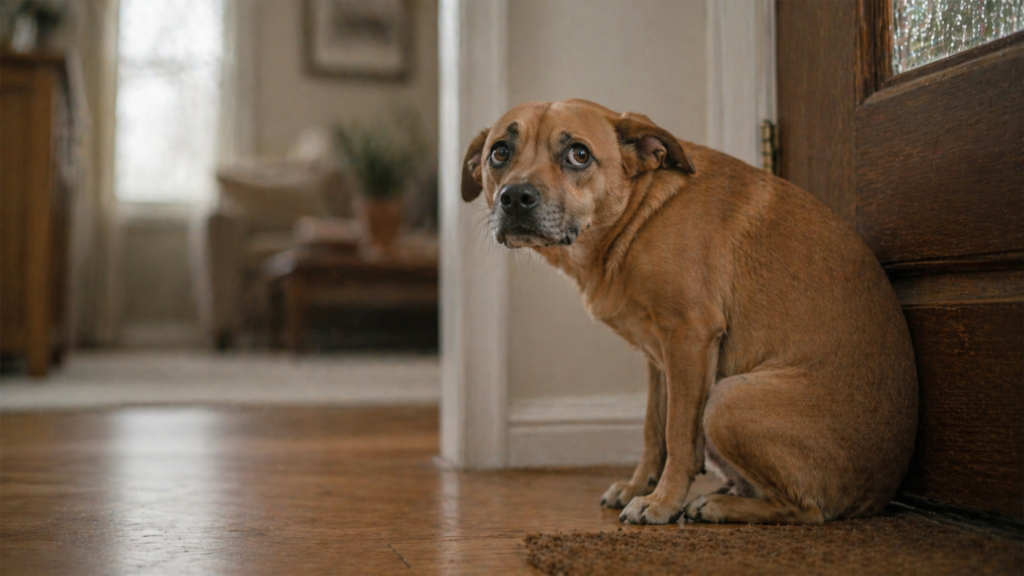
Most people notice the obvious stuff first — the chewed sofa, the neighbor complaints, the dog that won’t stop pacing. But by the time anxiety looks like that, it’s usually been building for a while. The earlier signs are quieter, easier to miss, and much easier to address.
This guide covers everything from subtle early signals to the specific patterns that point to separation anxiety — and how to tell whether what you’re seeing is actually anxiety at all.
IN THIS GUIDE
Signs of Anxiety in Dogs
Anxiety in dogs shows up on a spectrum — from barely-there signals most owners miss, to unmistakable distress. Knowing both ends helps you catch it earlier.
Subtle signs (the ones most people miss)
These are calming signals — behaviors dogs use to communicate stress. They’re easy to overlook because they look so ordinary.
- Yawning when not tired. Repeated yawning during training, greetings, or new situations is a stress signal, not boredom.
- Lip licking with no food present. A quick tongue flick is one of the most consistent early anxiety indicators.
- Deliberately looking away. Avoiding eye contact or turning the head is a dog’s way of saying “I’m uncomfortable.”
- Shaking off after interactions. A full-body shake after a stressful moment — like a wet dog shake — is a physical reset signal.
- Excessive sniffing at odd moments. Suddenly becoming intensely interested in the ground mid-interaction is often displacement behavior — doing something familiar to cope with stress.
- Whale eye. Visible whites of the eyes while the head stays still — a sign of conflict or discomfort.
None of these alone signal a problem. A single yawn isn’t anxiety. But a dog consistently showing several of these across different situations is communicating something worth paying attention to.
Clearer signs
These are the more recognizable dog anxiety signs and symptoms — harder to miss, and a more direct signal that anxiety is affecting daily life.
| Sign | What it looks like | Level |
|---|---|---|
| Panting / pacing | Heavy breathing or restless movement without physical cause | Mild |
| Clingy behavior | Following owner room to room, unable to settle alone | Mild |
| Trembling | Shaking without cold or illness | Moderate |
| Hiding | Retreating under furniture, into closets, behind people | Moderate |
| Loss of appetite | Refusing food in situations that were previously fine | Moderate |
| Excessive barking | Vocalization out of proportion to the trigger | Moderate |
| Destructive behavior | Chewing, scratching, digging — often at exit points | Severe |
| House soiling | Accidents despite being housetrained | Severe |
| Fear-based aggression | Growling or snapping driven by fear, not territory | Severe |
RULE THIS OUT FIRST
Panting, restlessness, and loss of appetite also show up in dogs that are in pain or unwell. If anxiety signs appeared suddenly with no obvious trigger, a vet check before assuming it’s behavioral is always worth doing.
Signs of Separation Anxiety in Dogs
Separation anxiety is a specific condition — not just a dog that dislikes being alone, but one in genuine distress when separated from their person. The treatment is different from general anxiety, so identifying it accurately matters.
The defining feature of separation anxiety dog signs is that they happen specifically when the dog is alone or anticipating being left — not just generally when stressed.
What it looks like day-to-day
- Pre-departure anxiety. Panting, pacing, or clinging while you’re still getting ready to leave — your dog has learned to read departure cues like keys and shoes.
- Vocalization that starts immediately after you leave. Barking or howling within minutes of departure that doesn’t settle — this is distress, not adjustment.
- Destruction at exit points. Chewing or scratching focused on doors, door frames, and windows — not random destruction, but escape attempts.
- House soiling when alone. Accidents from a housetrained dog that only happen during absences point to a stress response, not a training gap.
- Frantic greeting when you return. Prolonged, intense reunions — jumping, spinning, crying — that take 20+ minutes to calm down.
THE CAMERA FIRST
Set up a camera or pet monitor before you leave. What your dog does in the first 30 minutes after departure tells you more than almost anything else. A dog that settles within 5–10 minutes is very different from one still pacing and vocalizing an hour later.
At night
Signs of separation anxiety in dogs at night are common — particularly in dogs that sleep separately from their owner or that were recently moved out of the bedroom. Watch for whining or barking after lights go out, scratching at bedroom doors, overnight accidents from an otherwise housetrained dog, or restlessness that continues well into the night. We cover nighttime anxiety in more detail here.
FOR OLDER DOGS
Nighttime restlessness in dogs over 8 years old can signal canine cognitive dysfunction or undiagnosed pain — both of which disrupt sleep and look like anxiety. If nighttime symptoms are new and your dog is older, see a vet before assuming it’s behavioral. If your dog is a senior, anxiety in older dogs has some specific patterns worth understanding separately.
When it’s severe
Signs of severe separation anxiety in dogs are worth knowing because they indicate a level of distress that doesn’t respond to basic management alone:
- Self-injury — chewing paws or legs raw, scratching at doors until nails bleed
- Complete refusal to eat or drink when alone, even high-value food
- Physical stress symptoms: vomiting, diarrhea, excessive drooling specifically when left
- Camera footage showing distress that continues for the entire absence, not just at departure
- No improvement over weeks despite consistent routine
Severe separation anxiety almost always needs a combination of structured behavior modification and medication. A veterinary behaviorist — not just a trainer — is the right call at this level.
NEXT STEPS
Identified separation anxiety as the issue? Our full separation anxiety guide covers the desensitization protocol, when medication helps, and what to do when progress stalls.
Not sure if it’s separation anxiety or general anxiety? Our complete dog anxiety guide covers the bigger picture.
Anxiety vs. Bad Behavior: How to Tell
This is one of the most common points of confusion — and it matters, because responding to anxiety as if it’s a training problem makes things worse, not better.
Signs that point toward anxiety rather than deliberate misbehavior:
- The behavior happens in your absence. A dog that destroys things only when alone isn’t defiant — they’re distressed.
- Punishment doesn’t reduce it. Anxious behaviors are driven by emotional state, not calculated decisions. Coming home and punishing a dog for something they did hours ago accomplishes nothing and erodes trust.
- Physical stress signs accompany the behavior. Dilated pupils, sweaty paw prints, excessive shedding alongside the problematic behavior point to anxiety, not attitude.
- It’s worse in novel or stressful situations. Anxiety spikes with routine changes, new environments, and unfamiliar people. A dog “testing limits” doesn’t behave worse when their schedule changes.
- Exercise and enrichment don’t fix it. A bored dog improves with a long walk and a puzzle feeder. An anxious dog often doesn’t — the emotional state is the problem, not the lack of stimulation.
If you’ve been treating your dog’s anxiety signs as a training problem without progress, reframing it as an emotional issue — and responding with patience and structure rather than correction — often unlocks movement that months of training couldn’t.
How to Treat Separation Anxiety in Dogs
Once you’ve identified separation anxiety, the treatment approach is specific — and different from general anxiety management.
The foundation is desensitization: teaching your dog that short absences are safe, then very gradually building duration. This means starting with departures of seconds, not minutes, and only increasing when the dog is consistently calm. Most people go too fast, which is why progress stalls.
Paired with desensitization is counter-conditioning — associating your departure with something good. A frozen Kong given only when you leave is the classic example. Over time, your departure cues stop predicting distress and start predicting something positive.
Enrichment toys can also play a supporting role — a frozen Kong given only at departure, or a snuffle mat to redirect anxious energy. We cover the best options in our anxiety toys for dogs guide →
For moderate to severe cases, medication prescribed by a vet makes the behavior modification possible — it takes the edge off enough for the dog to actually learn. It’s not a substitute for training, but trying to desensitize a dog in full panic rarely works.
Common Questions
What are the early signs of separation anxiety in dogs?
Early signs of separation anxiety are often subtle: following you more than usual, becoming restless as you prepare to leave, or brief whining when a door closes. These are worth taking seriously — separation anxiety is much easier to address before it becomes entrenched. A camera check during an absence is the most reliable way to confirm whether genuine distress is happening when you’re gone.
Can a dog show signs of anxiety at night only?
Yes. Some dogs are calm during the day but show clear signs of anxiety at night — particularly around bedtime separation. This is common in dogs that sleep separately from their owners or that recently had a routine change. In older dogs, nighttime restlessness can also signal pain or cognitive decline, so it’s worth ruling those out before assuming the cause is purely behavioral.
Do dogs grow out of separation anxiety?
Rarely on their own. Unlike some puppy behaviors that fade with maturity, separation anxiety tends to stay stable or worsen without intervention. The good news is that it responds well to structured treatment — most dogs make meaningful progress with consistent desensitization, and many resolve completely. The earlier you address it, the better the outcome.
My dog only shows anxiety signs when I’m home — is that separation anxiety?
Not exactly. A dog that’s calm when you’re fully gone but distressed when you’re home and move to another room is showing what’s sometimes called velcro dog behavior — proximity anxiety rather than true separation anxiety. The distinction matters for treatment: the focus becomes desensitizing the dog to you moving around the house, not just to being left alone entirely.
Think you might be making things worse without realizing it?
Some of the most common ways owners respond to anxiety signs actually backfire. Here’s what to avoid.
Disclosure: As an Amazon Associate, Calm Dog Lab earns from qualifying purchases. This means if you click on a product link and make a purchase, we may receive a small commission at no extra cost to you.

Pingback: Dog Separation Anxiety: Real Answers to the Questions (2026)